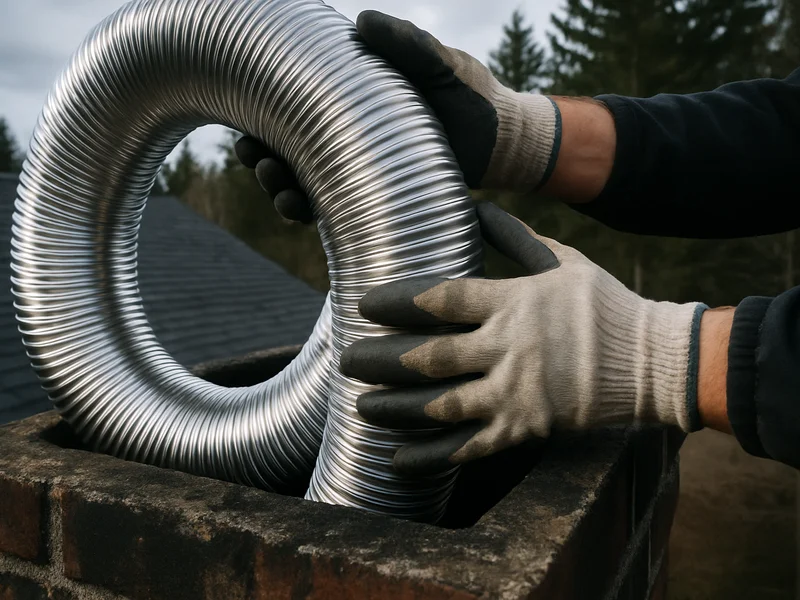
The liner has one job: keep flue gas and heat away from framing two inches behind the brick.
Clay flue tile is a good material and it fails here for a reason that barely applies elsewhere: the speed of the temperature swings.
These hills hold the world record for it. On 22 January 1943 a chinook took Spearfish from minus 4 degrees at 7:30 in the morning to plus 45 at 7:32 - forty-nine degrees in two minutes. It reached 58 by afternoon, and when the wind died it fell back to minus 4 in twenty-seven minutes. Window glass frosted and cracked from the shock. The record has never been broken.
That is an extreme example of an ordinary local event. Clay tile, the mortar joints between sections, and the masonry around them all expand at different rates, and a swing that fast does not give them time to move together. The joints open first, then the tile itself splits. It is a fatigue failure rather than a heat failure, which is why it turns up on chimneys that have never had a chimney fire and never been abused.
Plenty of what we line is not damaged at all. A masonry fireplace built with a 12 by 12 clay flue is correct for an open fire, which needs a lot of flue to carry a lot of cool, dilute smoke. Drop a wood insert with a six-inch collar into that opening and the appliance is now venting into a cross-section four to six times larger than it needs.
The exhaust expands, slows and cools long before the top, and cool exhaust condenses. That is where glaze comes from on houses that barely burn. A correctly sized insulated liner fixes the draft and the creosote rate together, and it is also what the appliance manufacturer's listing required in the first place.
Relining is the most expensive thing on this website and the easiest thing in the trade to sell to somebody who does not need it. So here are the numbers and the limits.
A straight, accessible flue taking an insulated stainless liner generally lands between $1,800 and $3,200. Offsets, very tall stacks, or tile that has to come out before the liner goes in push it to $3,200 and up. A small-diameter liner for a gas appliance is less. We give a range on the phone and a firm number after the flue has been measured, never before.
Now the other direction. A sound clay flue serving the open fireplace it was sized for does not need lining. Light surface pitting in an otherwise intact tile does not need lining. A single hairline crack in one section is worth photographing and watching, not ripping out. If somebody showed you a dark line on a screen and quoted five figures the same afternoon, ask for the footage and get a second opinion - and we will look at it for nothing whether or not you use us.
Footage or a photograph from any inspection, ours or somebody else's. We will tell you what it actually proves.
Rather talk it through
The survey is the cheap part and it settles the argument, whichever way it goes.