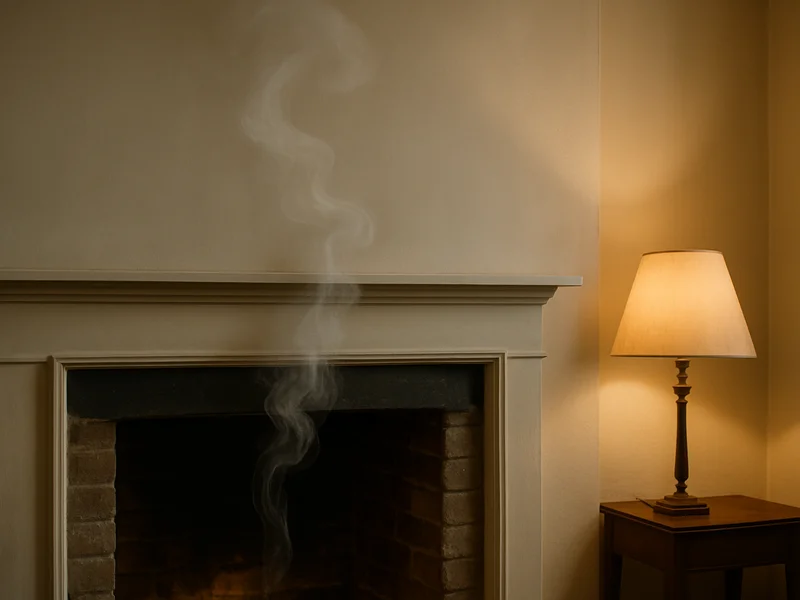
A fireplace that spills into the room is almost never a broken fireplace.
A chimney does not suck. Warm gas inside the flue is less dense than the cold air outside it, and that difference pushes the column upward. Everything that goes wrong with draft is something interfering with one side of that balance.
In the order we find them:
The house is winning. A modern airtight house with a powerful range hood, a bathroom fan and a dryer running has less air coming in than going out. The fireplace becomes the cheapest opening in the building and air flows down it, bringing smoke with it. This is the single most common cause we find in newer construction and no amount of chimney work fixes it.
The flue is the wrong size or the wrong height. Too wide and the exhaust cools before it reaches the top. Too short, or too close to a taller roof line, and it never establishes a column at all. Building practice asks for the top to sit at least two feet above anything within ten feet, and additions built years after the original house routinely break that.
The air outside is warmer than the air aloft. A temperature inversion removes the density difference the chimney relies on. That is not a fault and it cannot be repaired - but a correctly sized insulated flue keeps enough margin to work on the bad days rather than only the good ones.
Only then the appliance. A closed damper, a blocked cap, a bird nest, a disconnected flue collar.
Makeup air - a dedicated inlet so the fire is not competing with the kitchen - $400 to $1,200 depending on the run. A correctly specified cap to stop downdraft, $250 to $600. Extending the flue to clear a roof line, $600 to $1,500. Repairing or replacing a damper, $250 to $700. Where the answer is an insulated liner because the flue is oversized, that is relining and it is priced there.
Almost every smoking fireplace we are called to has already had somebody's guess applied to it. Usually a cap, sometimes a damper, occasionally a whole appliance. The guess costs several hundred dollars, the smoking continues, and the owner concludes that nothing can be done.
So we sell the measurement first and separately. A diagnostic visit is $140 to $200, it produces a written answer, and you are free to take that answer to anyone. If the finding is that your extractor hood is stronger than your chimney, we would rather hand you that sentence than sell you a cap that will not help.
The one thing we will not do is tell you a fireplace is unusable. Nearly all of these are fixable once the cause is actually known.
When it spills, what else is running in the house, and whether it is worse on some days. That narrows it before we arrive.
Rather talk it through
A written finding you can take to anyone, and most of these turn out to be cheap to fix.