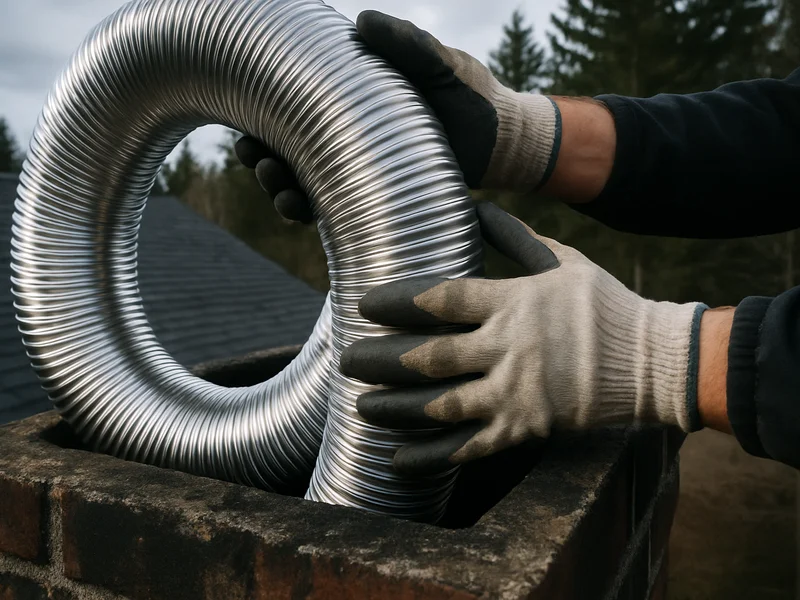
An insert dropped into a stack that never had a liner in the first place.
The oldest housing in Sturgis predates the practice of lining a chimney at all. Chimneys built before clay tile became standard are simply brickwork with a void up the middle - not a defect at the time, just how they were built, and plenty of them are structurally excellent.
The problem arrives when a modern appliance is connected to one. An airtight wood stove or an insert runs hotter, drier and at a different flue temperature than the open fires those stacks were built around, and there is nothing between the flue gas and the brickwork except a century of weathered mortar.
It goes like this, and we see it repeatedly. A foothills house has an original open fireplace on an unlined stack. At some point - often in the seventies, sometimes far more recently - somebody fits a wood insert into the opening to get real heat out of it. The insert is a good appliance and the installation looks tidy from the room. Nobody lines the flue, because from the firebox you cannot tell there is nothing there.
What follows is predictable. The insert's six-inch outlet is venting into a large unlined cavity, so the exhaust cools and condenses. Creosote forms fast. And because the brick is porous and the joints are old, some of that condensate goes into the masonry rather than up.
The tell from inside the house is a persistent campfire smell in the room on damp days, which is condensate in the brick rather than anything in the firebox. If that describes your house, a camera run is worth doing before winter.
Tell us roughly when the house was built and when the insert went in. That is most of it.
Rather talk it through
On this stock the survey genuinely changes the answer, in both directions.