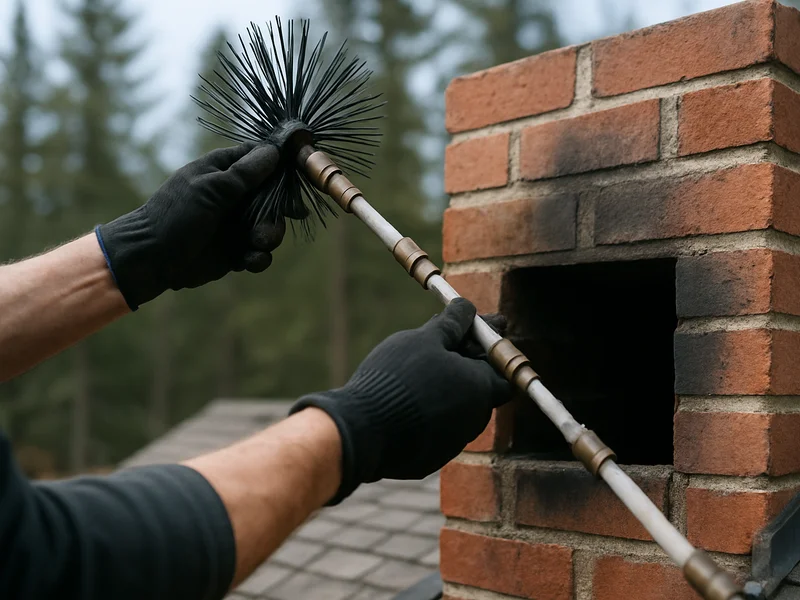
Creosote and nesting out, the whole flue inspected, and photographs of anything worth knowing about.
Creosote is not a single substance and the difference decides whether your chimney is a housekeeping job or a fire risk. Stage one is dry flaky soot that a brush removes in minutes. Stage two is crunchy and layered. Stage three is a hard black glaze that has run down the flue wall like tar and set - and that is the one that carries a chimney fire.
Which one you get is decided by how the appliance runs, not by how much wood goes through it. A stove burning steadily at temperature keeps the flue hot and the deposits light. A stove lit on Friday and left to die out on Sunday runs the flue cool and wet on every cycle and lays down glaze. That is why the worst flues we open in the Black Hills belong to weekend cabins rather than to the houses that burn the most.
Older Rapid City and Sturgis housing is mostly masonry with clay tile, where the questions are crown condition, mortar joints and whether the tiles have shifted. Newer construction - and almost everything in Box Elder - vents through factory-built systems: a metal firebox with stainless class A pipe inside a framed chase. There is no masonry to fail, but joints work loose, storm collars perish, and the inner wall corrodes where an appliance runs cool.
The practical difference on the day is the equipment. A poly brush correct for stainless will not shift glaze off clay tile, and a wire brush correct for clay will strip the inside of a stainless liner. We ask what you have before we load the van, which is why the phone call is longer than you might expect.
September and October fill first and they fill in that order. If the appliance is your actual heat, book before the first hard freeze. Cabins and weekend places are better done in the shoulder season, while the roads are dry and there is still time to fix whatever turns up.
A firm price over the phone before anyone has seen the chimney is the most reliable marker of the operators this trade is known for. It works because it gets revised - and it gets revised once the technician is already on your roof.
We give a range on the phone. Most single-flue sweeps land between $180 and $280, and a firm number once we know the roof pitch, the appliance and whether it is one flue or three. Tall stone chimneys, steep metal roofs and anything needing rope access cost more, and you will know that before we book rather than after.
The other half of the same problem is the finding that appears mid-job. If we open something and find a genuine surprise, we stop and show you the photograph, and you decide. Nothing gets added to the invoice that you have not looked at first.
A photo of the stack or the appliance tells us more than anything you can type.
Rather talk it through
September and October fill first. Tell us the appliance and roughly when it was last done.